
Building resilience among tribal women by growing climate resilient crops in Koraput
“Earlier, we had to be tied to a moneylender for seed money. Sometimes we had to tie up gold ornaments and sometimes houses. But those times are gone, now we have become owners of various varieties of seeds. With enthusiasm and determination, and the help of government and private organizations, women in tribal-dominated areas are producing improved and indigenous seeds and storing it themselves,” says 60-year-old Haribola Sukia of Machhara village in Koraput district.
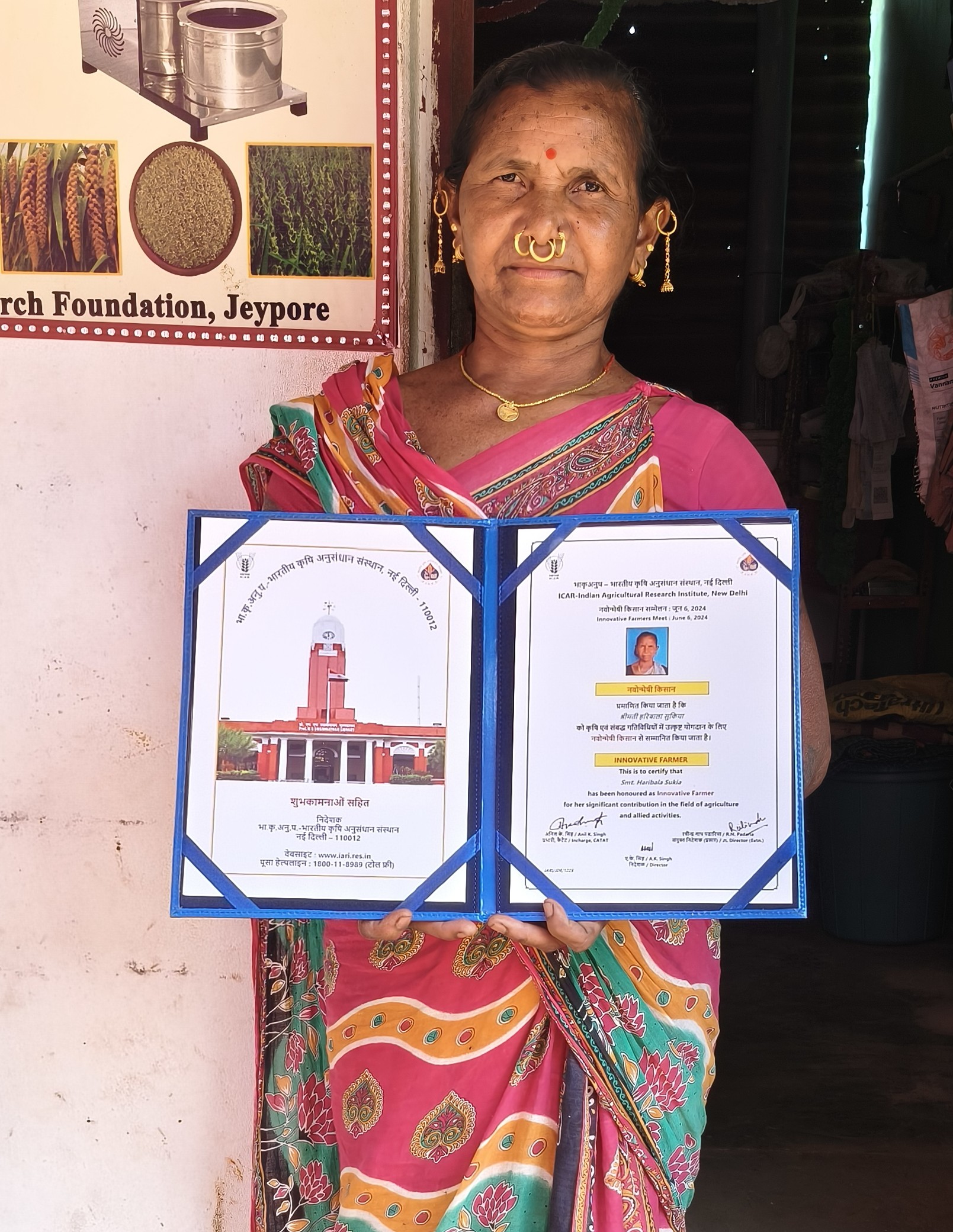 | 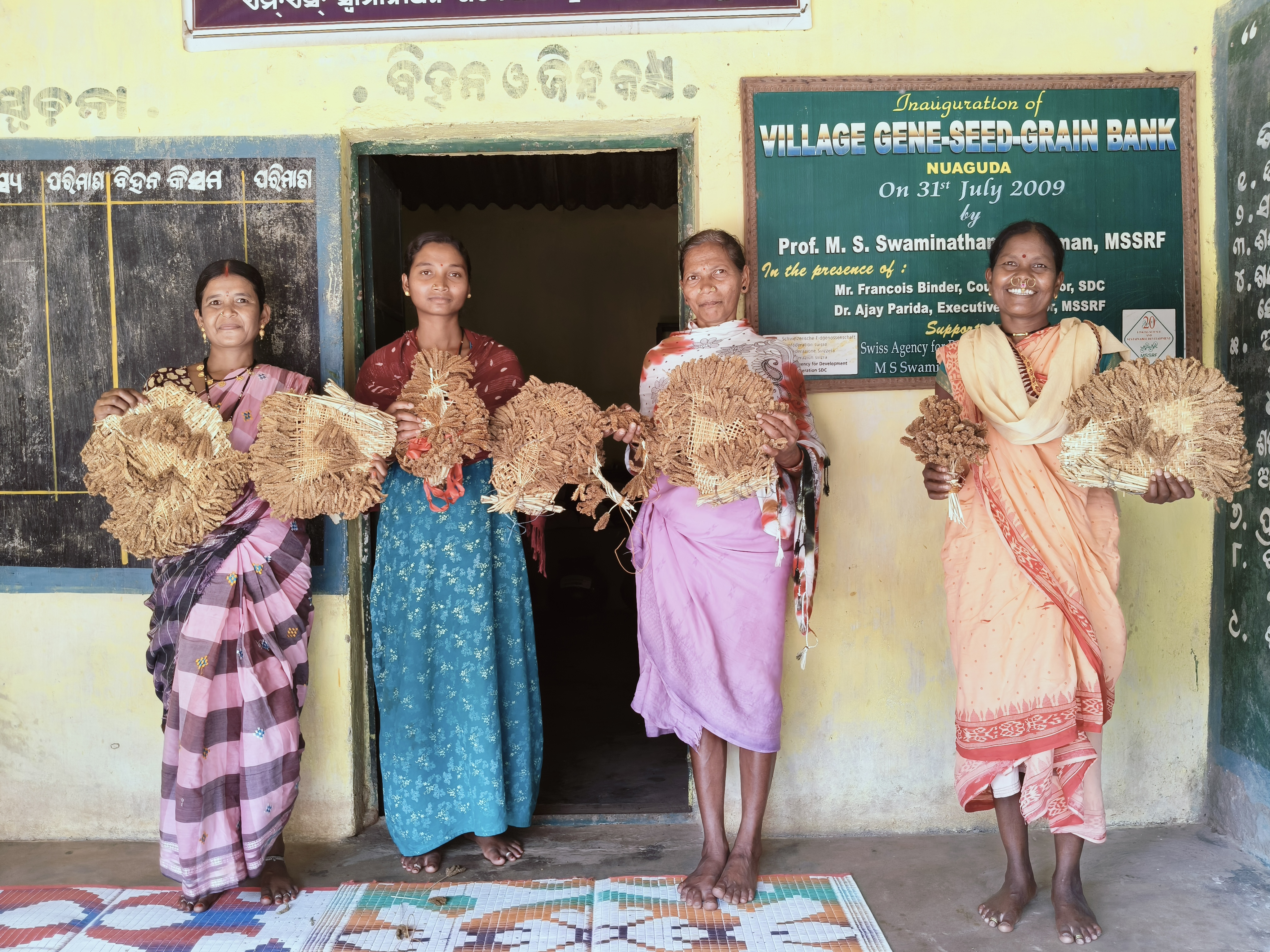 |
| Image 1: Horibola Sukia recognized with the ICAR award for Millet Seed Producer and Innovative Farmer | Image 2: Community Seed Bank managed by Group of Women SHG at Kundra Block Koraput District |
With continuous efforts, she has herself produced 3,500 kgs of finger millet on her 3 acres of land, out of which she has sold 750 kgs of VL Mandua-380 variety seed and has become self-reliant. Moreover, Haribola has also been recognized for her significant contribution in the field of seed production in New Delhi.
Many women like Haribola in the tribal-dominated Koraput district are involved in the millet seed production. They are playing an important role in ensuring food security and economic empowerment by being involved in the production of improved seed varieties. They are showing by example, how to increase income and empowerment among their communities by producing and storing quality seeds. They have gained self-reliance and formed a unique identity by providing quality seeds such as Arjun, Kalua, Chilika, KMR-204, VL Mandua-380, etc. finger millet seeds, to the government and the farmers of their region.
Under the Kolab Farmers Producers Organization of Koraput block, women farmers have been able to produce improved variety seeds and sell them and are earning and transforming the way climate-tolerant crops are grown. Last year, 30,950 kgs of improved seed varieties produced by the farmers under the organization were given to the Odisha State Seed Corporation of the state government. Out of them, 62 women have made a profit by selling more than 14,500 kgs of seeds. Apart from this, seeds were also sold to various institutions.
The state government had started “Shree Anna Abhiyan” to promote millets. In this context, to increase the improved variety seed production of millets, since 2018, the MS Swaminathan Research Foundation (MSSRF) in Koraput, Jeypore has been providing farmers with high-quality millet seed varieties under the Rastriya Krushi Vikas Yojana. Along with this, training has also been given on improved agronomic practices. Women farmers associated with the institute have taken a leading role in taking forward the ‘alternative seed production system.’ As a result, 30% more yield has been achieved compared to the indigenous variety.
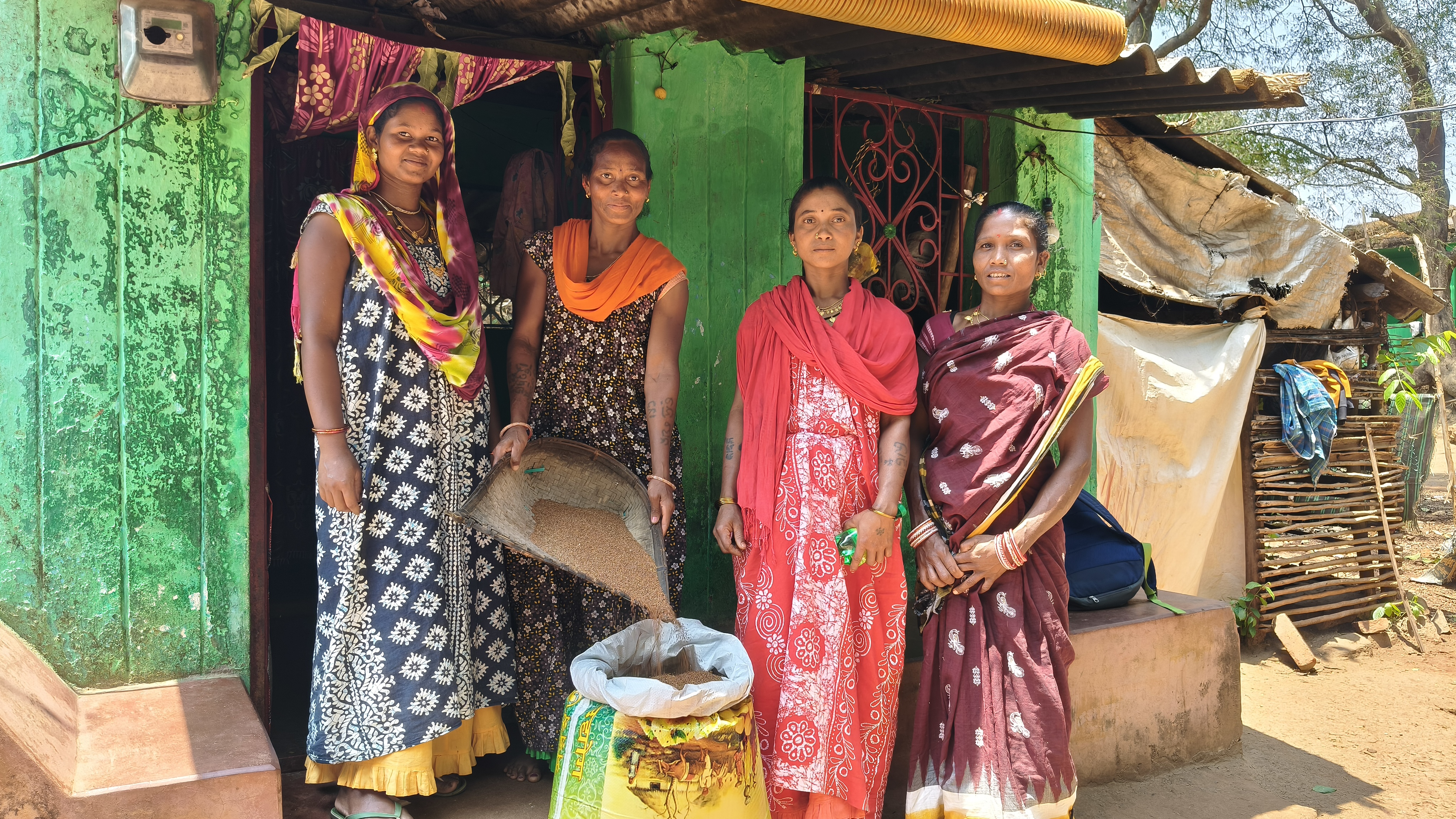 |
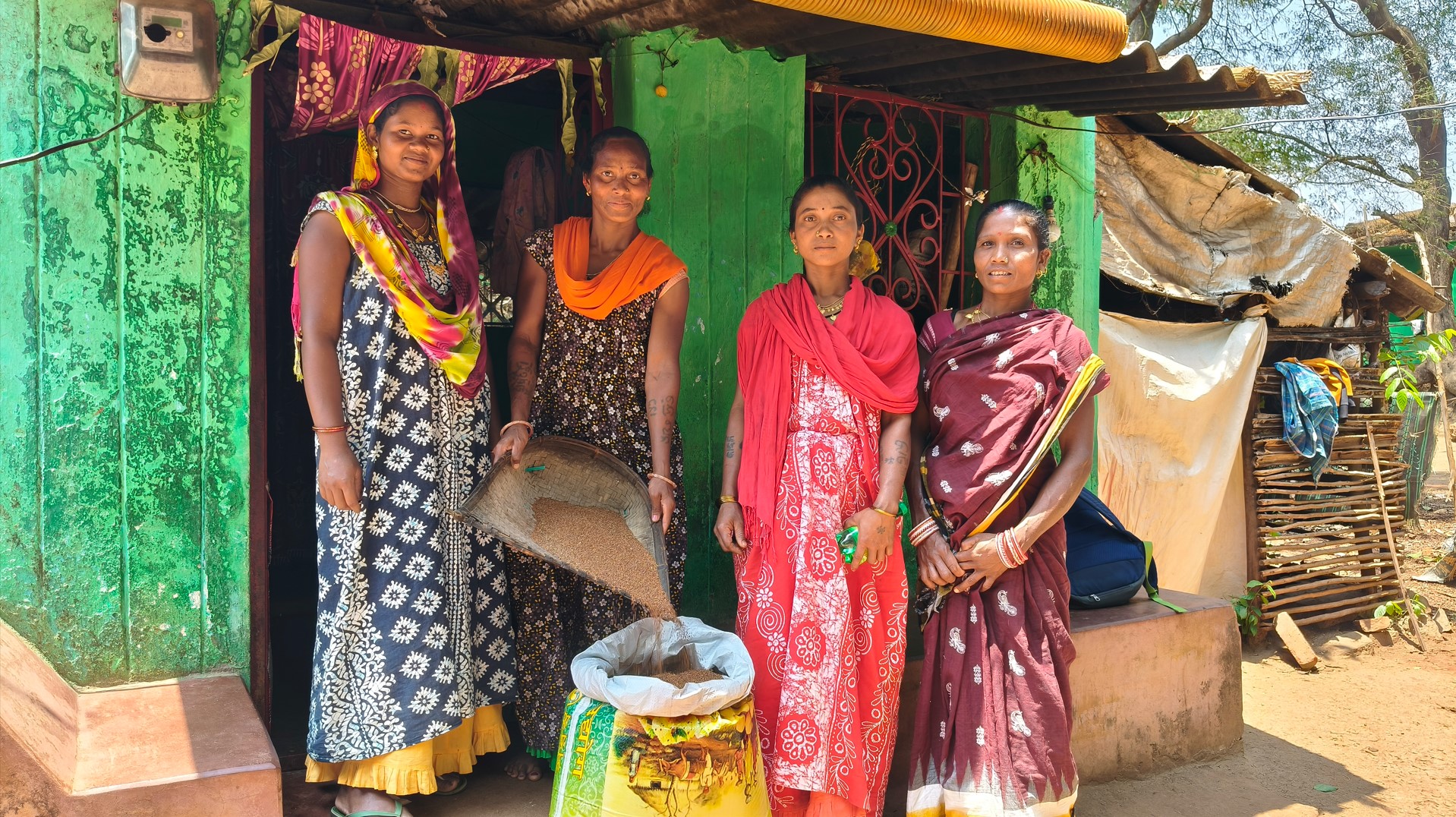
| Image 3: Group Of Women Farmers and seed Producers at Machra Village Koraput district |
In this regard, a woman farmer Dana Bhoi says, “While earlier we were only growing finger millet for eating at home, now we are able to produce improved variety seeds and make a profit. I came to know about how to produce finger millet seeds through MS Swaminathan Research Foundation. I have cultivated 1,900 kgs of Arjun finger millet seeds this year on 3 acres of land.” Due to which she has become financially empowered and has succeeded in promoting the sustainable farming system.
According to Chitta Chandia, a woman farmer, she has been able to earn more by producing various finger millet seeds for the last 7 years. Last year, she sold 2,200 kgs and 50 kgs of finger millet seeds and 2,600 kgs of finger millets produced on 4 acres of land and earned lakhs of rupees.
Similarly, in Kundra Block Nuaguda village, 10 women of the self-help group are taking care of a community seed center under the Bamandei Production Company in collaboration with MSSRF. In this, they have collected seeds of Bati, Bhairavi, Sorghum, Bada Mandia, Sana Mandia, Bhalu Mandia etc. from farmers. Along with this, they are also collecting and selling seeds of other crops. Farmers from different districts are buying seeds from them. Last year, SHG women collected 600 kgs of seeds from farmers in the village and nearby villages and sold 450 kgs of seeds, making a lot of profit.
In this regard, the SHG president Chandrama Masiya says, "Today, the women of our village have become empowered. Apart from farming, our members have now become able to earn by taking care of the seed center. They have been able to spend for themselves and their families.
Published in Odia Daily Leading Newspaper ‘The SAMBAD’
This story was covered by Aiswarya Parija as part of the Mina Swaminathan Fellowship which was constituted in 2020, with the intention to amplify and spotlight MSSRF’s gender intersections.
 | About Aiswarya: A journalist with nine years of experience of reporting on human rights issues, development stories and gender-related topics. She is currently with WASSAN, a national - level – nonprofit organization as Communication and Media Coordinator. She also writes and contributes articles to various Odia newspapers. Her work has been recognized with accolades such as the LAADLI MEDIA AWARD for 'Best News Report' in 2018 & 2024 and the ODISHA MEDIA AWARD for 'Gender Based Reporting' in 2018 and 2024. |