
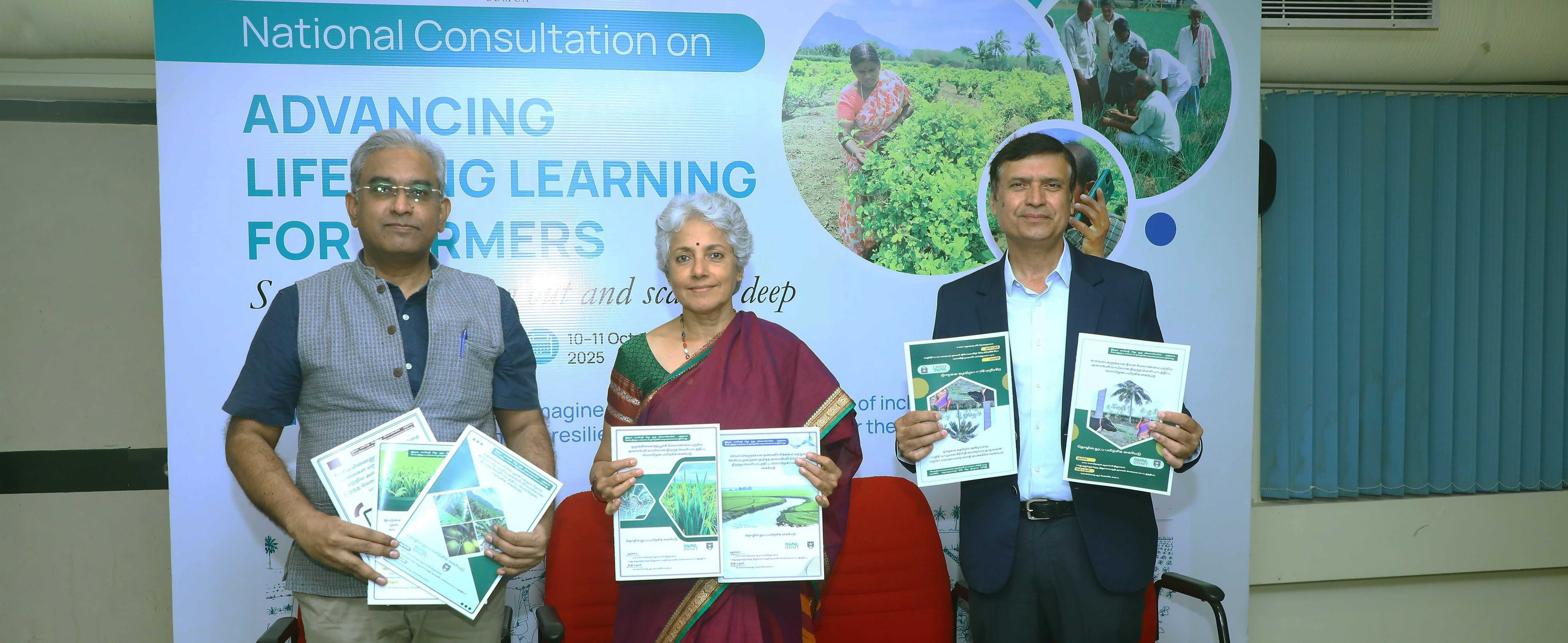
National Consultation on Advancing Lifelong Learning for Farmers
Published On
10 October 2025
Published On
10 October 2025
The National Consultation on “Scaling Up, Scaling Out and Scaling Deep: Advancing Lifelong Learning for Farmers (L3F)” commenced at the MS Swaminathan Research Foundation (MSSRF), Chennai, on 10th October 2025 with a series of insightful addresses from distinguished speakers. The event marks a pivotal moment in the evolution of the L3F initiative, which has empowered smallholder farmers, particularly women, through ICT-enabled, credit-linked, and community-driven learning systems over the past two decades.
Dr. B. Shadrach, Director of CEMCA, opened the session by emphasising the importance of placing farmers at the center of technological and learning interventions. He highlighted the success of L3F in bridging the gap between technology and rural communities, echoing Professor Swaminathan’s vision of translating “Lab to Land and Land to Lab.” Dr. Shadrach advocated hyperpersonalised learning models using mobile platforms and MOOCs, supported by human insight. He stressed the need for data-driven approaches, digital literacy, and ethical data governance, proposing the integration of AI and machine learning with frugal innovations to address farmers’ challenges and build climate resilience.
In the keynote address, Dr. K. Balasubramanian, Former Vice President of the Commonwealth of Learning (COL), provided a historical perspective on the genesis and evolution of L3F. He noted that COL’s focus on non-formal sectors such as agriculture and health led to the development of L3F, which fosters both horizontal and vertical knowledge sharing. Dr. Balasubramanian shared the importance of combining human, financial, and social capital for sustainable success, and called for improving existing extension systems that act as facilitators rather than instructors.
Dr. Soumya Swaminathan, Chairperson of MSSRF, delivered a special address drawing parallels between lifelong learning in agriculture and the medical field, referencing the ECHO platform. She emphasised the value of collaborative and inclusive learning, and shared MSSRF’s ongoing efforts to promote gender equity, including a memorandum of understanding with Maharashtra to support women’s land ownership rights. Dr. Swaminathan highlighted the potential of AI tools like Bhashini for translating information in various Indian languages and the importance of enabling frontline workers to harness their own data. She also discussed MSSRF’s participatory approach to digital tool development, such as the Fisher Friend Mobile Application (FFMA) application for fishers to access weather, ocean state, market and government information; and a new heat and health management tool, reinforcing the foundation’s commitment to inclusive innovation.
Dr. Satender Singh Arya, CEO of the Agriculture Skill Council of India (ASCI), concluded the inaugural session by addressing the critical need for skilling in agriculture, which employs over half of India’s workforce. He emphasized that only 25% of the workforce is currently skilled and advocated for integrating L3F into national skill development policies. Dr. Arya proposed strategic collaborations with the Ministry of Skill Development, ASCI, and MSSRF, and recommended including L3F in the Digital Agriculture Mission. He also highlighted ASCI’s contributions to skilling through courses on carbon farming and emissions in the fishing value chain and encouraged the creation of hubs with state-level missions such as the Tamil Nadu Skill Mission.
Together, these inaugural addresses set the tone for a forward-looking dialogue on advancing L3F from 2025 to 2035, with a focus on inclusive partnerships, digital innovation, and sustainable development for India’s farming communities.
MSSRF Contributors: Mr Seenivasan and Dr Gopinath
CEMCA contributors: Dr Nabeela and Dr Shadrach