
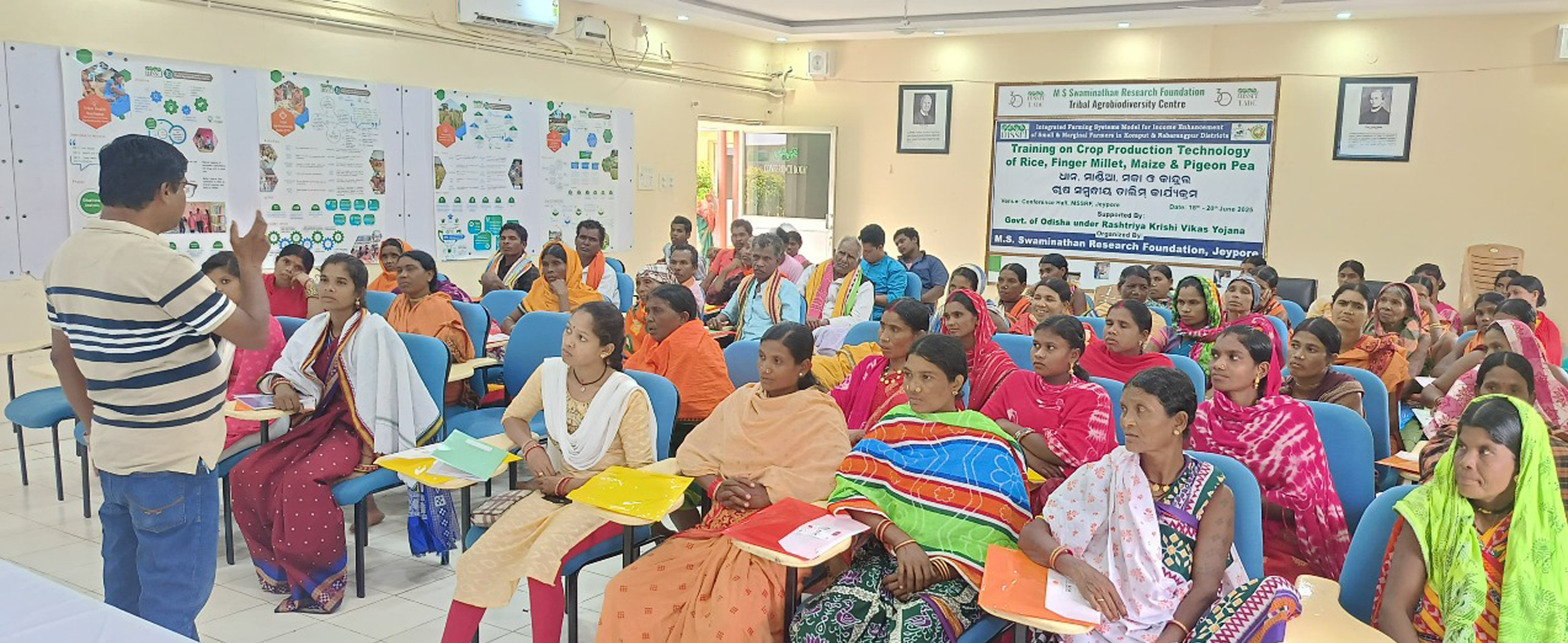
MSSRF Conducts Six Training Sessions on Crop Production Technology in Odisha
As part of the Integrated Farming System project, the M.S. Swaminathan Research Foundation (MSSRF), Jeypore, organized a comprehensive series of six training sessions on Crop Production Technology focusing on rice, finger millet, maize, and pigeon pea. These sessions were held from 18th to 20th and 23rd to 25th June 2025 with the aim of enhancing farmers' incomes through empowering and adoption of improved scientific crop production technology and sustainable agricultural practices. A total of 225 farmers (129 male, 96 female) from Kosagumuda block of Nabarangpur and Boipariguda block of Koraput districts have actively involved.
The training programme commenced with a pre-training assessment to evaluate the existing knowledge and farming practices of the participating farmers. Shri G. Venkat Reddy, Former Chief District Agriculture Officer of Nabarangpur, served as the resource person. He acknowledged and appreciated the traditional wisdom of the farmers while encouraging them to integrate scientific methods into their cultivation practices for improved productivity and sustainable income. He emphasized the importance of treating agriculture as an enterprise and shared several successful case studies to inspire the farmers.
During the training, farmers were introduced to advanced techniques in the cultivation of finger millet, including land preparation, the System of Millet Intensification (SMI), seed treatment, nursery management, and scientific transplanting methods. The sessions also addressed practical approaches to weed and nutrient management, such as the use of cono weeders, log rolling, and roughing, along with strategies for managing blast disease.
In the rice production module, farmers learned about selecting suitable varieties, conducting soil tests, preparing nursery beds, and applying the System of Rice Intensification (SRI) method for planting. They were also trained in effective weed control, balanced fertilizer application, and the role of zinc sulphate in preventing Khaira disease. Emphasis was placed on integrated plant protection techniques and the importance of using Dhanicha as green manure to maintain and enhance soil fertility. The programme also included a detailed session on intercropping maize with pigeon pea, explaining the recommended row ratio of 2:1, appropriate plant spacing, seed rate, and nutrient application. This practice was highlighted for its benefits in income diversification and natural nitrogen fixation, contributing to both economic and ecological sustainability.
To assess the impact of the training, a post-training evaluation was conducted, followed by an engaging interactive session where farmers shared their feedback, clarified doubts, and expressed a strong willingness to adopt the demonstrated techniques in their fields. This initiative by MSSRF underscores the importance of combining traditional knowledge with modern agricultural science to build resilient and sustainable farming systems. By equipping farmers with the tools and knowledge needed to improve productivity and income, the programme contributes significantly to rural development and environmental sustainability.