
Exposure Visit on Sustainable Aquaculture: MSSRF and WorldFish Host Odisha Government Delegation
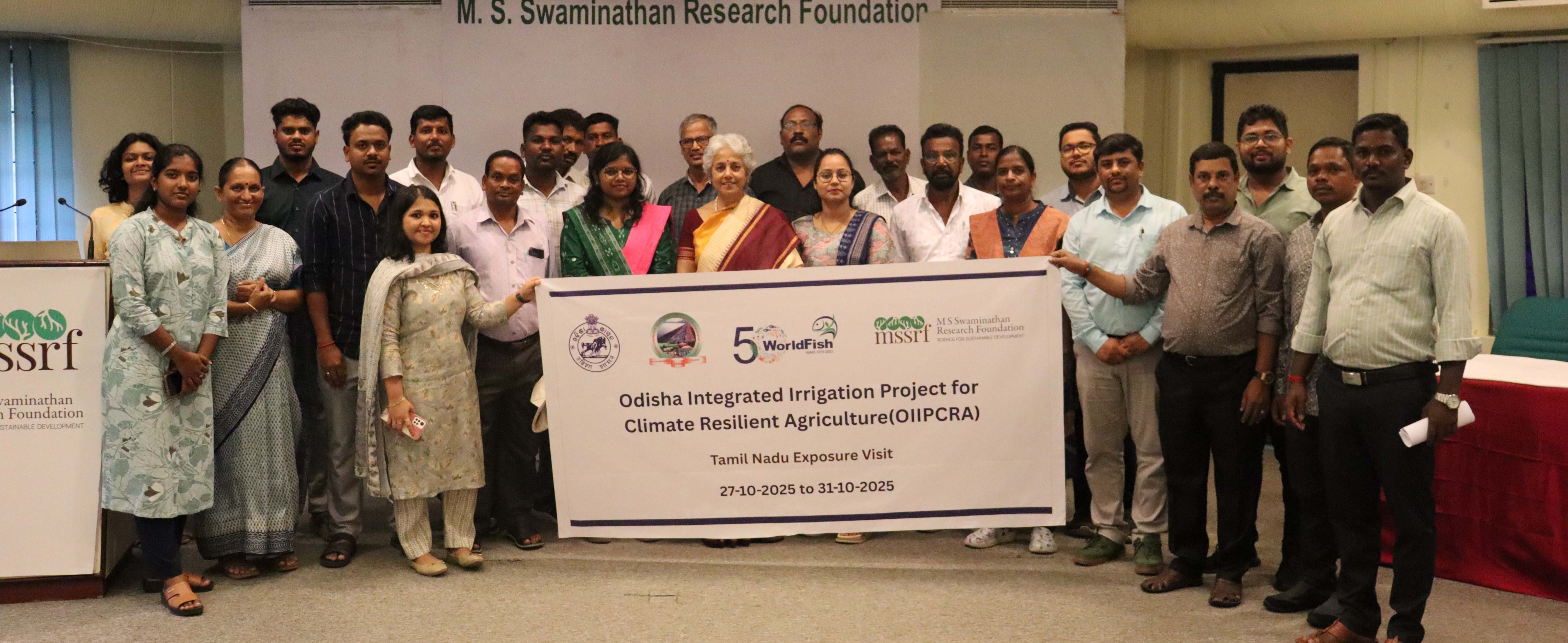
From 26th to 31st October 2025, a 20-member delegation from the Government of Odisha, under the Odisha Integrated Irrigation Project for Climate Resilient Agriculture (OIIPCRA), is undertaking an exposure visit to Tamil Nadu, facilitated by the MSSRF’s Coastal and Marine Systems Programme in collaboration with WorldFish. The visit seeks to equip participants—government officials, fish farmers, hatchery operators, and WorldFish staff—with practical insights into sustainable and climate-resilient aquaculture systems. Key focus areas include advanced hatchery and nursery management, integration of aquaculture with mangrove and coastal ecosystems, community-led aquaculture, women’s participation, and innovations across the post-harvest value chain. The broader objective is to identify replicable models that can enhance resilience and livelihoods in Odisha’s climate-vulnerable coastal regions.
The exposure visit commenced with an inaugural meeting at the MSSRF office, Chennai, Sambasivam Auditorium, on 27th October 2025.
Mr. Amar Gaikwad, Project Manager, WorldFish – OIIPCRA Project, emphasized WorldFish’s role in advancing climate-smart aquaculture with World Bank's support. Addressing Odisha’s cyclone-prone context, he highlighted their goal to learn from Tamil Nadu’s models and identify feasible technologies that could be adapted to build greater climate resilience in Odisha. Mr. Gaikwad also underlined the project’s commitment to foster connections and collaborations with the farmers of Tamil Nadu.
Dr. Velvizhi, Area Director – Coastal and Marine Systems, MSSRF provided a detailed walkthrough of the five-day itinerary, outlining how the program blends technical sessions with field-based learning. The first day’s agenda includes visits to the Central Institute of Brackishwater Aquaculture (CIBA) in Muttukadu and to the Seabass Nursery Unit in Kottaikadu. At the respective sites, participants interacted with CIBA experts on hatchery operations—particularly seabass, mud crab, and shrimp—and learned how local Self-Help Groups manage community nurseries, achieving significant turnover through sustainable practices.
Dr. Rengalakshmi R., Executive Director – Area Operations, MSSRF introduced MSSRF’s longstanding initiatives in coastal and marine systems, biodiversity, ecotechnology, and agriculture, nutrition and health (ANH). She also explained how gender inclusion and climate adaptation underpin MSSRF’s research and implementation work across ecosystems.
Dr. Ramasubramanian R., Senior Fellow, MSSRF drew on his three decades of mangrove research to share the foundation and evolution of MSSRF’s pioneering participatory mangrove conservation efforts initiated in 1988. He outlined key restoration interventions, including fishbone canal systems that enhance tidal flow and regulate soil salinity, alongside the establishment of mangrove nurseries. Emphasizing the significance of Integrated Mangrove Fishery Farming System (IMFFS), he explained how combining the cultivation of mangroves and halophytes (salt-tolerant plants) with the culture of fish, crabs, and prawns provides practical pathways toward sustainable coastal aquaculture. These models not only strengthen the resilience of coastal communities but are also implemented by MSSRF through processes that ensure active participation from local communities and forest departments.
Dr. Soumya Swaminathan, Chairperson of MSSRF, delivered a special address on the need for deeper research into mangrove ecosystems and their crucial role as bioshields against climate disasters. She reflected on MSSRF’s longstanding collaboration with the Government of Odisha and highlighted tangible outcomes from joint initiatives, such as the latest update on the “Fisher Friend” mobile application, which alerts fishers to Olive Ridley turtle nesting sites and helps protect this endangered species. She also reaffirmed the shared commitment to ecosystem restoration, women’s empowerment, and the promotion of sustainable coastal livelihoods.