
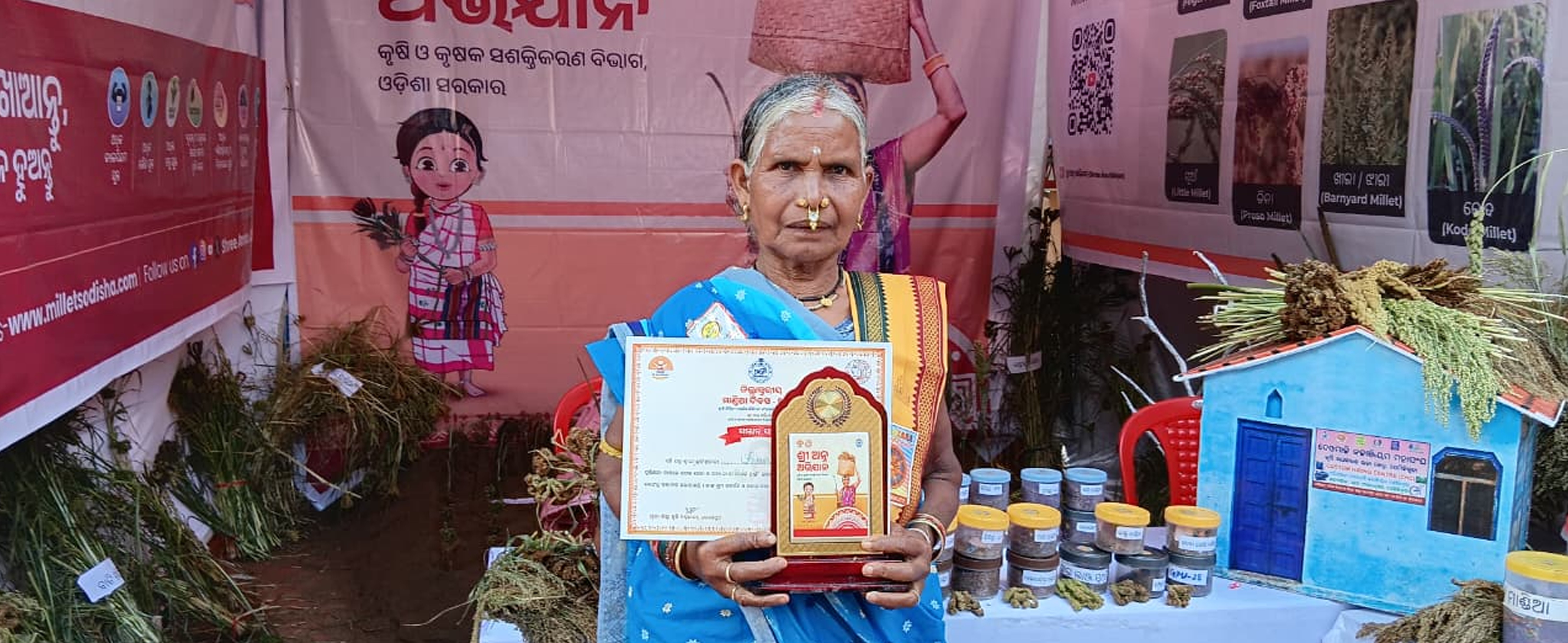
Somari Hantal, a model farmer reviving millets in Koraput
In Goloriguda village of Koraput district, Odisha, 56-year-old Somari Hantal has become an inspiring example of how right training and determination can transform small farms. Living in a joint family with her husband and son, Somari depended entirely on agriculture for livelihood. On their 1.75 acres of land, along with 2.5 acres of leased upland, she cultivated paddy and finger millet during the Kharif season using traditional methods. With limited access to technical knowledge such as seed selection, treatment, fertiliser management, and pest control, Somari’s finger millet yield remained low - just 2 to 3 quintals per acre.
To address such challenges, the M.S. Swaminathan Research Foundation (MSSRF) began working on millet promotion in the early 2000s, aiming to reintroduce millets as a climate resilient and nutritious crop that fits local farming systems. After extensive groundwork and collaboration with the state, the Odisha Millet Mission (OMM) was launched in 2017 by the Department of Agriculture and Farmer’s Empowerment. Its goal was to reintegrate finger millet into Odisha’s food system through a farm-to-fork approach, covering production, processing, marketing and inclusion in government schemes.
What began as a pilot in five villages with fewer than 200 households has now reached nearly 200 villages and over 7500 farmers, including Somari.
Farmers received hands-on training on seed selection, seed treatment, Integrated Nutrient Management (INM), and Integrated Pest Management (IPM). They were also encouraged to use quality local seeds and adopt transplanting through the System of Millet Intensification (SMI) technique.
Somari first learned about SMI through MSSRF's implementation of OMM. She applied the method during the Rabi season of 2020, transplanting 15-day-old seedlings at 25 × 25 cm spacing, using a cycle weeder, and applying organic inputs such as Jeevamruta and Handikhata.
SMI, also known as System of Finger Millet (Ragi) Intensification (SFMI) or the System of Ragi Intensification (SRI) is a farming approach adapted from the principles of the System of Rice Intensification (SRI). It enhances millet productivity while reducing input use, and using wider spacing, transplanting of young seedlings, and promoting strong root growth to encourage more tillers (side shoots) and improve resilience of the crop.
Her results were remarkable. Each hill- or the small clump of millet plant growing from one planting spot- produced 15 to 18 tillers, and each panicle, which is the flowering head of the millet plant, had eight fingers (branches that bear the grains). Somari’s yield increased to 31.70 quintals per hectare, surpassing her earlier output. Her success and contribution of growing millets was recognised at the Mandia Divas (Millet Day) on 10 November 2025, where she received the ‘Best SMI Farmer’ award.
"I am proud to show others my field, and my hard work has finally yielded success,” Somari said after receiving the award from the district administration.
Encouraged by her achievements, many women in the Goloriguda village have started adopting similar agricultural practices. Her farm field now serves as a model for others to learn from. Somari's journey is a testament to how scientific training, coupled with farmer enthusiasm, can significantly enhance yield and improve rural livelihoods.
Pratap Chandra Jena is a Development Assistant at MSSRF, Odisha.